
Generate and Refine Flows with Natural Language Prompts
For the complete documentation index, see llms.txt. For a full content snapshot, see llms-full.txt. Append.mdto anykestra.io/docs/*URL for plain Markdown.
Build and modify flows, ask questions about Kestra, and get AI-driven plans — all from a persistent chat sidebar.
The AI Copilot opens as a right-side panel from the AI button in the top toolbar. Click New chat + to start a conversation, or use Recents to return to a previous one. Conversations persist for the browser session. You can type prompts or click the microphone button to dictate with speech-to-text.
Modes
The Copilot has three modes, selectable from the dropdown at the bottom left of the chat panel:
| Mode | What it does |
|---|---|
| Ask | Answers questions about Kestra using docs-grounded responses. Ask about features, configuration, plugin options, or get help diagnosing a failed execution. |
| Edit | Generates and iteratively edits flow YAML. Describe what you want to build; the Copilot drafts the change and asks for confirmation before applying it. |
| Plan | Proposes a step-by-step plan for a complex task. Each step requires individual approval before the Copilot executes it. Rejecting any step cancels the plan. |
Switch modes at any point in a conversation — the Copilot carries the conversation history across mode switches.
| If you want to… | Use |
|---|---|
| Build, modify, or refactor a flow | Edit |
| Diagnose a failed execution | Ask |
| Ask about Kestra features, plugins, or configuration | Ask |
| Complete a multi-step task with approval at each step | Plan |
Context
The Copilot automatically attaches the resource you are viewing as context when you open the panel. Attached resources appear as dismissible pills above the input. You can remove any pill to narrow the Copilot’s focus, and the transcript records each add and remove so you always know what the agent is looking at.
Resources that can be attached as context:
- Flow
- Namespace
- Execution
- Dashboard
- App
- Test suite
- Blueprint
- Plugin
Copilot also reads Namespace metadata — Policies, Variables, Secrets, and Key-Value pairs — so prompts like “Create a task that integrates with MongoDB” can reuse your configured credentials and variables without extra hints.
Confirmation
In Edit and Plan modes, actions that modify resources (creating or updating a flow, restarting an execution) require explicit confirmation before the Copilot executes them. A confirmation prompt appears in the chat with an optional field to steer the next step. Approving executes the action; rejecting resumes the conversation in Edit mode or cancels the current plan in Plan mode.
Edit mode
Edit mode generates and iteratively refines declarative flow YAML. Describe what you want to build; the Copilot searches available plugins, validates the generated YAML, and proposes the change for your approval. Once accepted, you can keep iterating — adding triggers, adjusting tasks, or refactoring a section — without the Copilot touching unrelated parts of the flow.
Edit mode is available anywhere you build in Kestra — Flows, Apps, Unit tests, and Dashboards.
Usage limits
When no custom provider is configured, Kestra uses a built-in AI service with a daily generation limit per instance. The UI shows how many generations you have left, and the limit resets daily at midnight UTC.
To remove the limit, configure your own LLM provider in the kestra.ai.providers block. See Configuration below.
Configuration
To add Copilot to your flow editor, add the following to your Enterprise and Advanced configuration. The providers array lets you register multiple LLMs and pick a default (is-default: true):
kestra: ai: enabled: true # set to false to disable AI Copilot entirely providers: - id: gemini display-name: Gemini - Private type: gemini configuration: model-name: gemini-2.5-flash api-key: YOUR_GEMINI_API_KEY - id: gpt display-name: OpenAI type: openai is-default: true configuration: model-name: gpt-4o api-key: YOUR_OPENAI_API_KEYLegacy single-provider configs (kestra.ai.type + provider block) still work, but the providers array lets you register multiple providers and choose a default (is-default: true).
Disabling AI Copilot
To fully disable the AI Copilot — including the built-in fallback to the api.kestra.io service — set kestra.ai.enabled to false:
kestra: ai: enabled: falseWhen disabled, the Copilot UI will not appear and all AI endpoints will be deactivated. The property defaults to true.
Multiple providers
When multiple providers are configured, users can switch models from a dropdown in the Copilot UI instead of relying only on the default.
For a full reference of every configuration property — including generation parameters, extended reasoning, mTLS, custom headers, and per-provider availability — see the AI Copilot configuration reference.
timeout: Specifies the maximum duration to wait for an AI model API request to complete before timing out. ISO 8601 duration format (Java Duration):PT30S= 30 seconds. You can set it per provider to enforce strict SLAs.
Enterprise Edition includes an RBAC permission that lets administrators allow or disallow Copilot usage per role at tenant or namespace scope.
The open-source version supports only Google Gemini models. Enterprise Edition users can configure any LLM provider, including Amazon Bedrock, Anthropic, Azure OpenAI, DeepSeek, Google Gemini, Google Vertex AI, Mistral, OpenAI, OpenRouter, and all open-source models supported by Ollama. See Enterprise Edition Copilot configurations below. If you use a different provider, reach out to us and we’ll add it.
Build flows with Edit mode
Open the Copilot sidebar, select Edit mode, and describe what you want to build. The Copilot searches for the right plugins, generates validated YAML, and proposes the change for your approval. The flow is marked Valid before the proposal is shown — you will not be asked to apply broken YAML.
Step 1: Build the initial flow
Create a flow that downloads a CSV from S3 and loads it into Postgres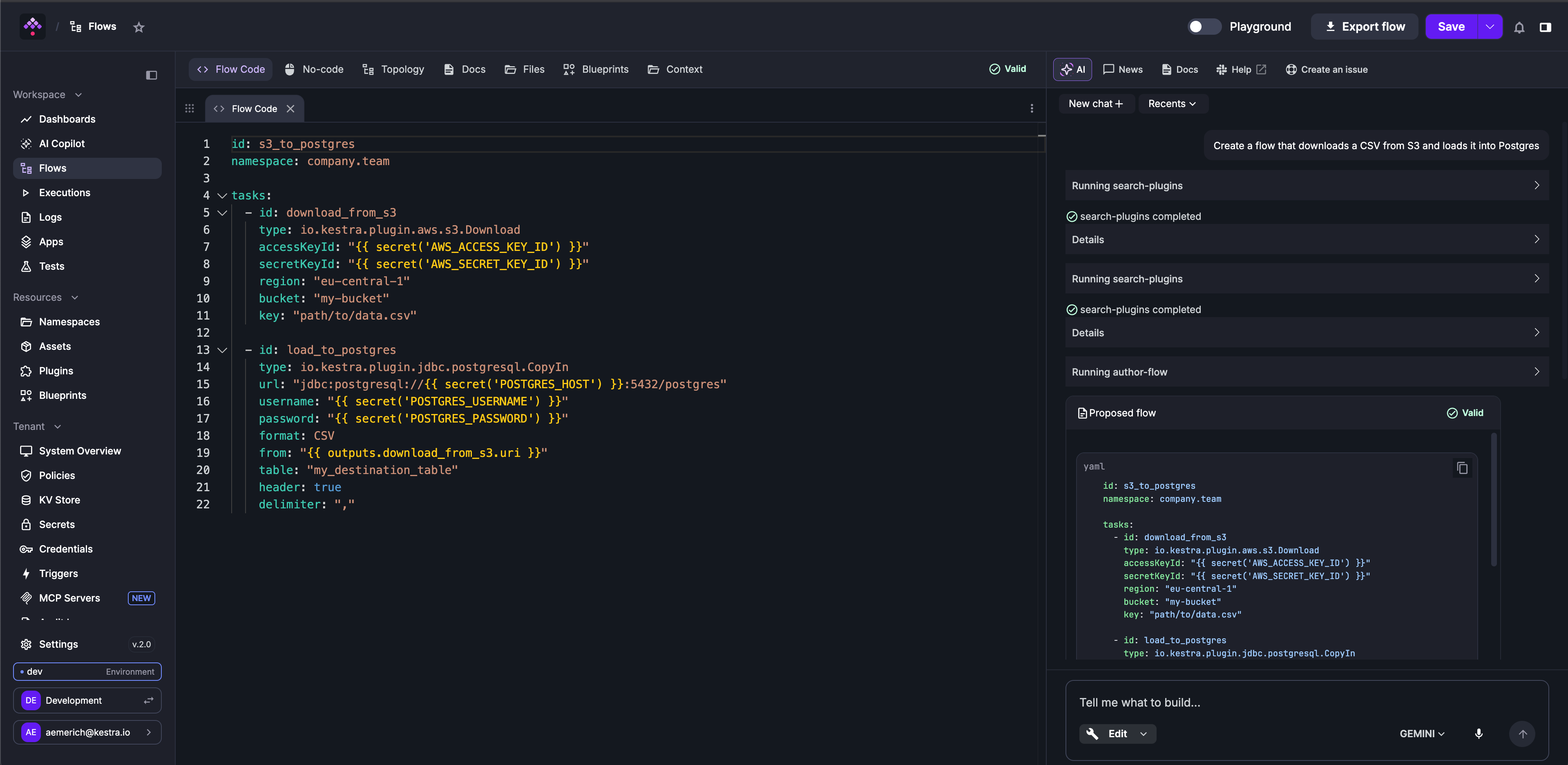
The Copilot searches for the S3 and Postgres plugins, authors the flow with secrets referenced via {{ secret('...') }}, and presents the proposal. Select Apply to write it to the editor, or Open in editor to review the diff before accepting.
Step 2: Add error handling
Add error handling that sends a Slack alert if any task fails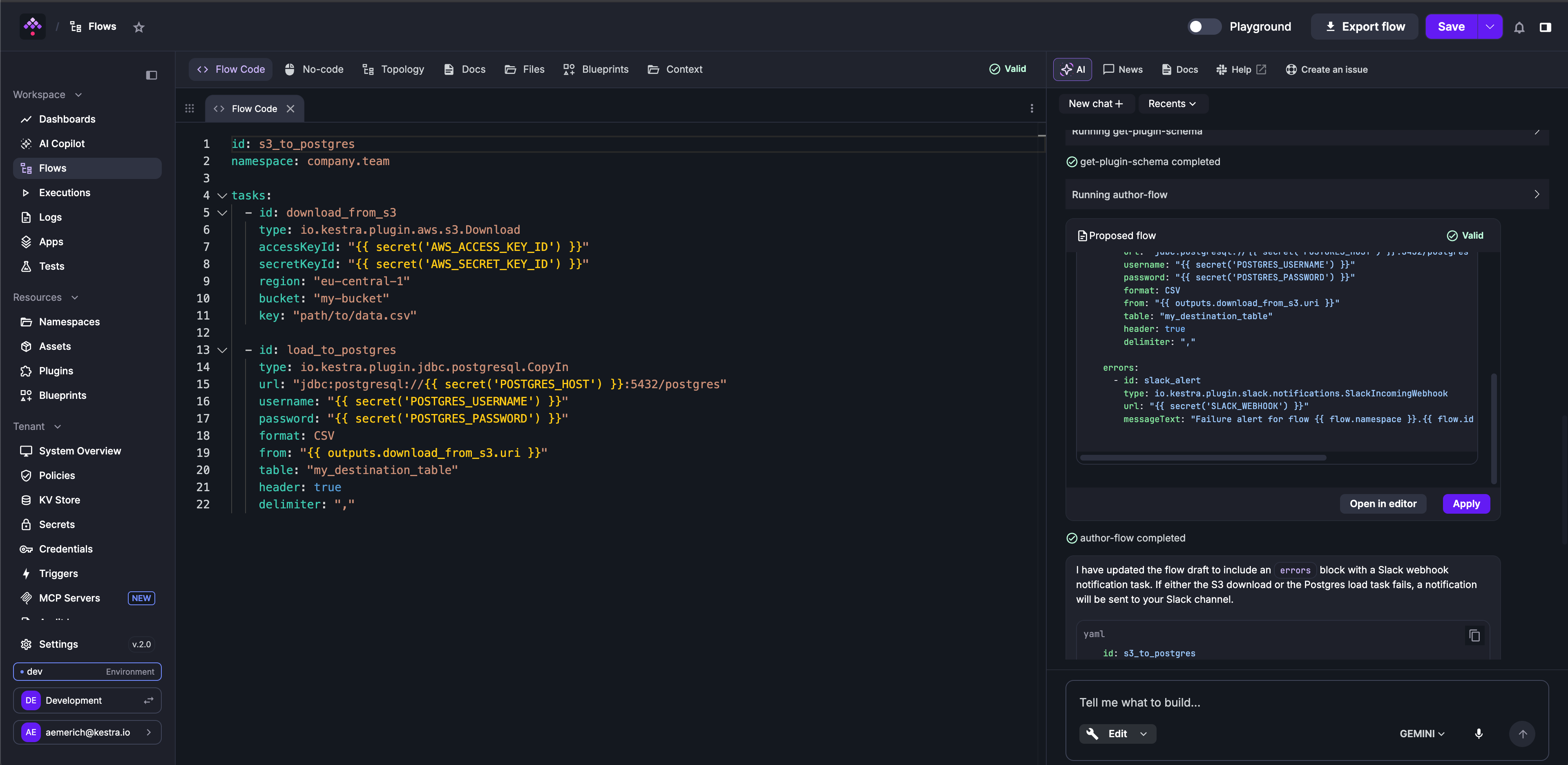
The Copilot updates only the errors block — the existing download_from_s3 and load_to_postgres tasks are untouched. The Copilot explains what it changed before presenting the proposal.
Step 3: Parameterize hardcoded values
Parameterize the S3 bucket name and Postgres table as flow inputs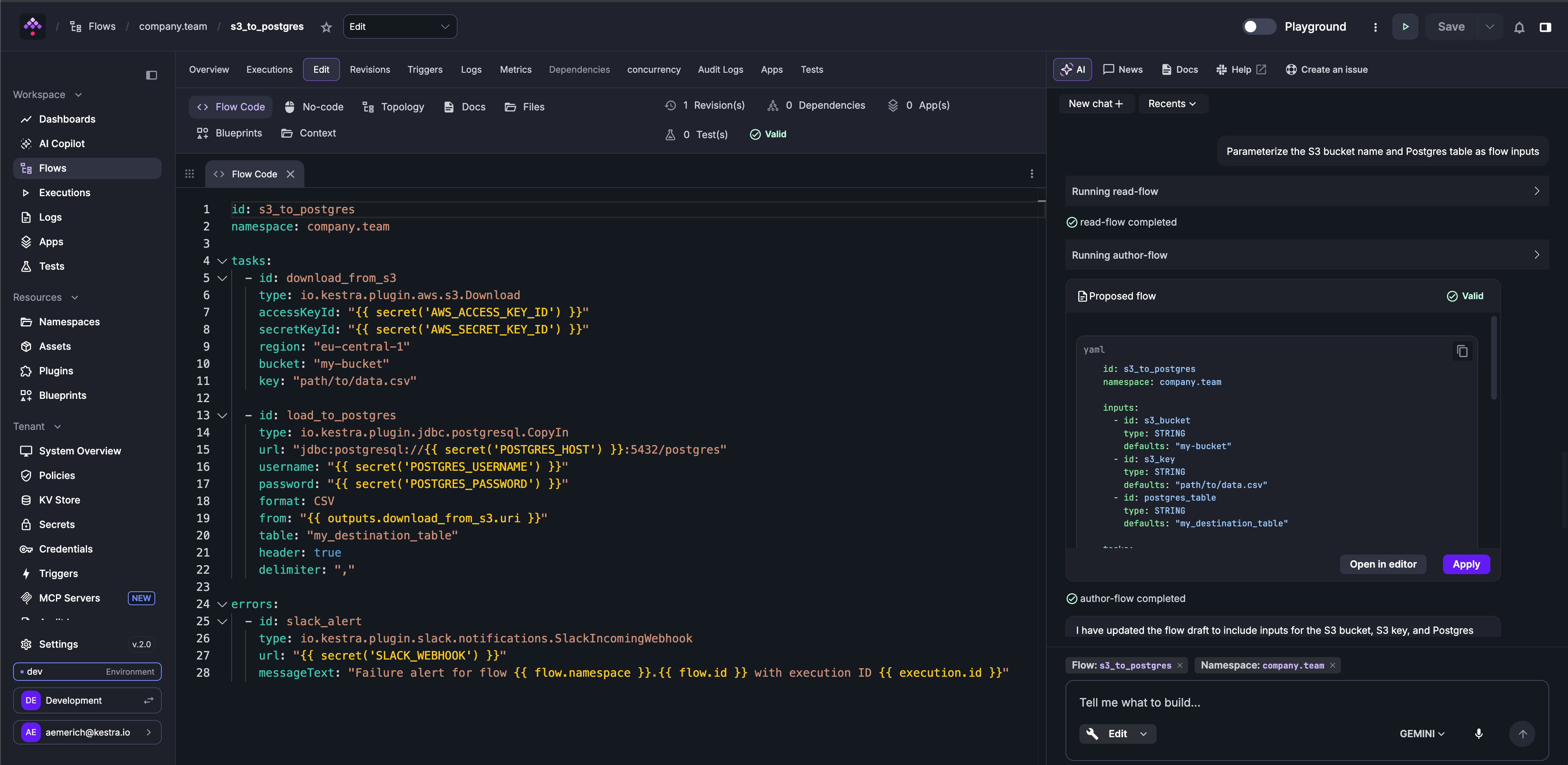
The Copilot reads the current flow (note the read-flow step in the sidebar), adds an inputs block with s3_bucket, s3_key, and postgres_table, and rewires the hardcoded values to {{ inputs.* }} references throughout the flow. The flow and namespace context pills are attached automatically while working inside the editor.
Each accepted change is saved as a revision. You can track the full edit history from the Revisions tab, or use Git sync to push revisions to your repository.
Ask mode
Use Ask mode to ask natural-language questions about Kestra without generating any code. Ask mode grounds its answers in the Kestra documentation and can analyze execution failures by reading the execution logs directly.
Diagnosing a failed execution
When you open the Copilot from a failed execution view, the execution is automatically attached as context. Ask “Why did this execution fail?” and the Copilot reads the execution metadata and logs, then gives a structured answer: which task failed, the root-cause error, and what to fix.
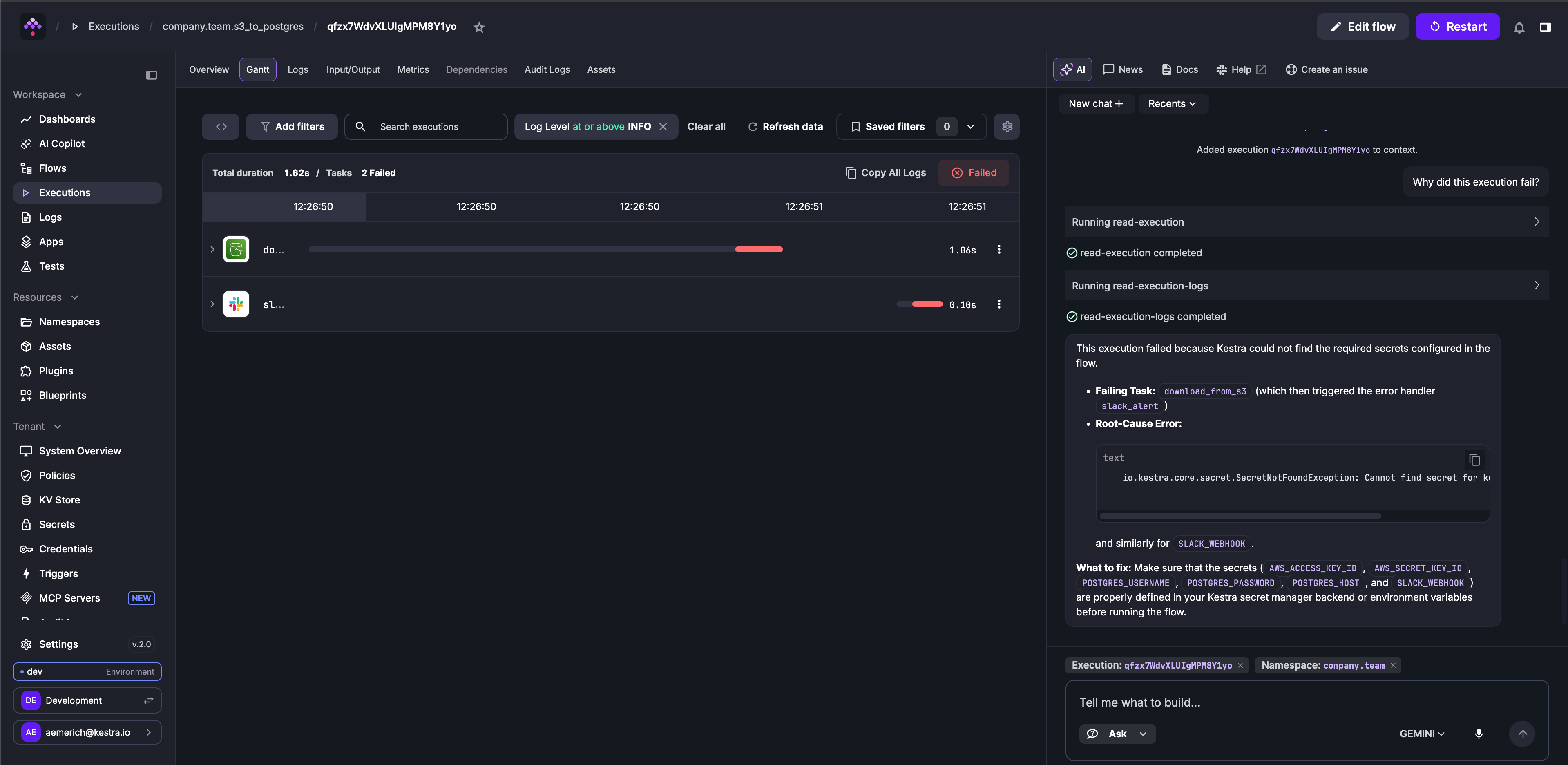
In the example above, the Copilot ran read-execution and read-execution-logs, identified that the download_from_s3 task failed due to SecretNotFoundException, and listed exactly which secrets — AWS_ACCESS_KEY_ID, AWS_SECRET_KEY_ID, POSTGRES_USERNAME, POSTGRES_PASSWORD, POSTGRES_HOST, and SLACK_WEBHOOK — need to be configured before running the flow again.
Other example questions:
- “What is the difference between a Worker Group and a Task Runner?”
- “How do I configure namespace-level Policies?”
- “What secrets and variables are available in this namespace?” (with a namespace attached as context)
Ask mode is also a useful starting point before switching to Edit or Plan — use it to understand your options, then switch modes to act on the answer.
Plan mode
Use Plan mode when a task involves multiple ordered steps that you want to approve individually before the Copilot executes them. Plan mode presents the full plan upfront as a numbered list, then waits for your confirmation before starting. You can approve and execute the plan, or reply to revise it before anything runs.
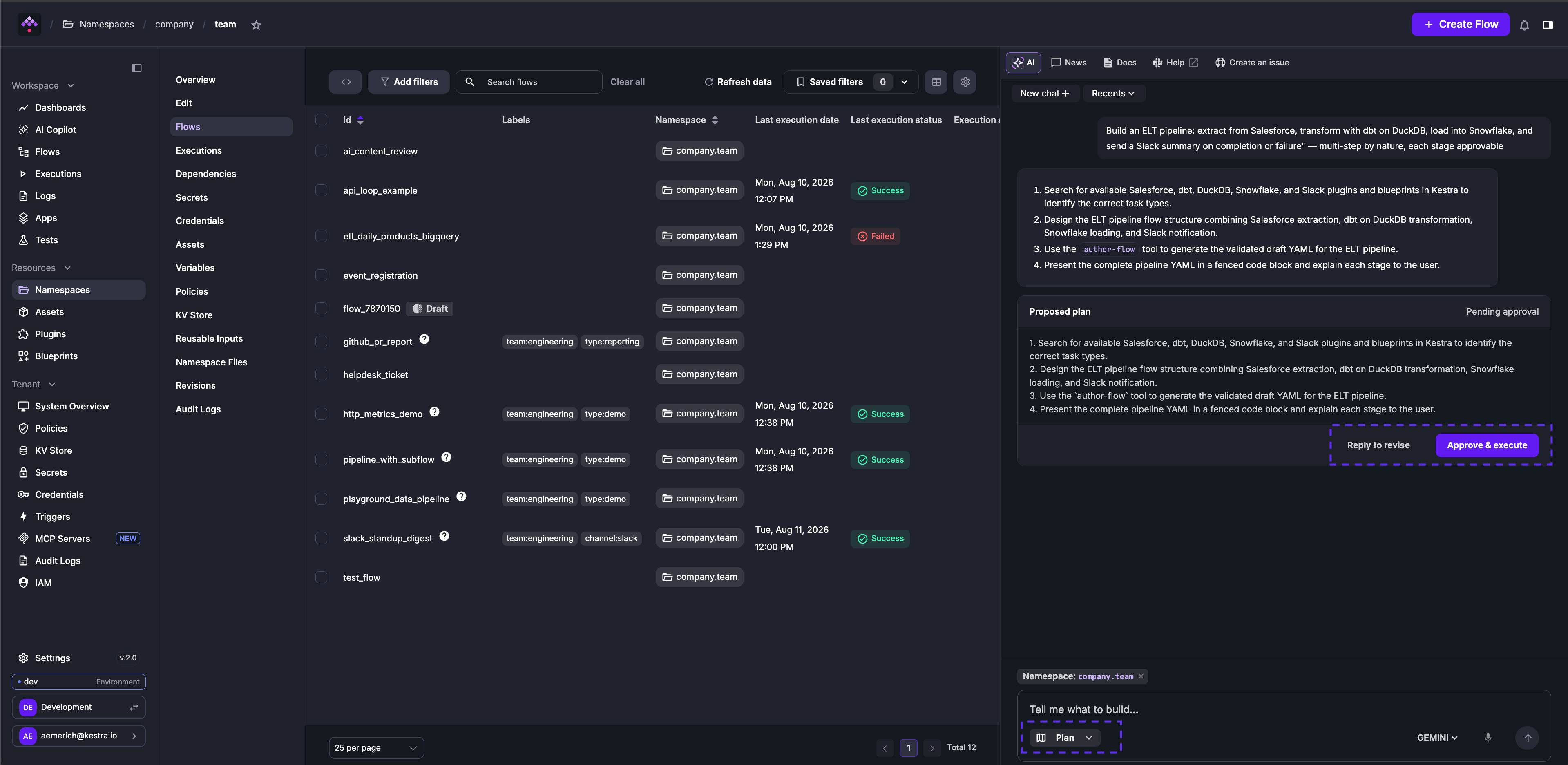
In the example above, the prompt “Build an ELT pipeline: extract from Salesforce, transform with dbt on DuckDB, load into Snowflake, and send a Slack summary on completion or failure” produced a four-step plan. The company.team namespace pill is attached, so the Copilot can reference available plugins and credentials in that namespace.
Rejecting a step cancels the remaining steps. If you want to adjust the plan before it runs, use Reply to revise to send feedback and get a revised plan.
Use Plan mode for tasks like:
- Building a multi-stage pipeline where you want to review the structure before any YAML is generated
- Migrating flows from one pattern to another (for example, from
ForEachto the Loop task) across multiple steps - Setting up namespaces, variables, and RBAC in sequence for a new team
Fix with AI
From the Logs and Gantt views, click the three-dot menu on any failed task and select Fix with AI. The flow editor opens with the Copilot pre-loaded with the error context in Edit mode, ready to propose a fix.
Starter prompts
Edit mode prompts
- Create a flow that runs a dbt build command on DuckDB- Create a flow cloning https://github.com/kestra-io/dbt-example Git repository from a main branch, then add a dbt CLI task using DuckDB backend that will run dbt build command for that cloned repository using my_dbt_project profile and dev target. The dbt project is located in the root directory so no dbt project needs to be configured.- Create a flow that sends a POST request to https://dummyjson.com/products/add- Send a POST request to https://dummyjson.com/products/add- Write a Python script that sends a POST request to https://dummyjson.com/products/add- Write a Node.js script that sends a POST request to https://dummyjson.com/products/add- Create a flow with a Python script that fetches weather data for New York City- Make a REST API call to https://kestra.io/api/mock and allow failure- Create a flow that logs "Hello from AI" to the console- Create a flow that returns Hello as output- Create a flow that outputs Hello as value- Run a flow every 10 minutes- Run a flow every day at 9 AM- Run a shell command echo 'Hello Docker' in a Docker container- Run a command python main.py in a Docker container- Run a script main.py stored as namespace file- Build a Docker image from an inline Dockerfile and push it to a GitHub Container Registry- Build a Docker image from an inline Dockerfile and push it to a DockerHub Container Registry- Create a flow that adds a string KV pair called MYKEY with value myvalue to namespace company- Fetch value for KV pair called MYKEY from namespace company- Create a flow that downloads a file mydata.csv from S3 bucket named mybucket- Create a flow that downloads all files from the folder kestra/plugins/ from S3 bucket mybucket in us-east-1- Send a Slack notification that approval is needed and Pause the flow for manual approval- Send a Slack alert whenever any execution from namespace company fails- Fetch value for string kv pair called mykey from Redis- Fetch value for mykey from Redis- Set value for mykey in Redis to myvalue- Sync all flows and scripts for selected namespaces from Git to Kestra- Create a flow that clones a Git repository and runs a Python script- Export a Postgres table called mytable to a CSV file- Query a Postgres table called mytable- Find documents in a MongoDB collection called mycollection- Load documents into a MongoDB mycollection using a file from input mydata- Trigger an Airbyte connection sync and retry it up to 3 times- Run an Airflow DAG called mydag- Orchestrate an Ansible playbook stored in Namespace Files- Run a DuckDB query that reads a CSV file- Fetch AWS ECR authorization token to push Docker images to Amazon ECR- Run a flow whenever 5 records are available in Kafka topic mytopic- Submit a run for a Databricks jobAsk mode prompts
- Why did this execution fail? (attach the execution as context)- What secrets and variables are available in this namespace? (attach the namespace as context)- What is the difference between a Worker Group and a Task Runner?- What plugins are available for working with Kafka?- How do I configure RBAC so developers can run flows but not edit them?- What is the best way to handle retries for a flaky HTTP API?- How do I pass outputs from one task to the next?- What does the errors block do and when should I use it?- How do I schedule a flow to run only on weekdays?- What is the difference between Namespace Variables and the KV Store?Plan mode prompts
- Build an ELT pipeline: extract from Salesforce, transform with dbt on DuckDB, load into Snowflake, and send a Slack summary on completion or failure- Migrate all ForEach tasks in this flow to use the Loop task- Add retry logic, error notifications, and a timeout to every task in this flow- Set up namespaces for dev, staging, and prod with RBAC roles for the engineering team- Create a flow that ingests data from five different S3 paths in parallel, merges the results, and loads them into BigQueryEnterprise Edition Copilot configurations
Enterprise Edition supports Amazon Bedrock, Anthropic, Azure OpenAI, DeepSeek, Google Gemini, Google Vertex AI, Mistral, OpenAI, OpenRouter, and all open-source models via Ollama. Add one or more provider blocks inside kestra.ai.providers and set is-default: true on the one Copilot should use by default.
Some Ollama model tags resolve to thinking models behind the scenes (for example, qwen3:30b-a3b points to a thinking variant). Thinking models that cannot have thinking disabled will produce incorrect YAML. Check that your chosen model supports a non-thinking mode, or use thinking-enabled: false where the provider supports it.
Amazon Bedrock
kestra: ai: providers: - id: bedrock display-name: Amazon Bedrock type: bedrock configuration: model-name: amazon.nova-lite-v1:0 access-key-id: BEDROCK_ACCESS_KEY_ID secret-access-key: BEDROCK_SECRET_ACCESS_KEYAnthropic
Anthropic does not accept an api-key configuration field. Set the ANTHROPIC_API_KEY environment variable on the Kestra server instead.
kestra: ai: providers: - id: anthropic display-name: Anthropic type: anthropic configuration: model-name: claude-opus-4-5Azure OpenAI
kestra: ai: providers: - id: azure-openai display-name: Azure OpenAI type: azure-openai configuration: model-name: gpt-4o-2024-11-20 api-key: AZURE_OPENAI_API_KEY tenant-id: AZURE_TENANT_ID client-id: AZURE_CLIENT_ID client-secret: AZURE_CLIENT_SECRET endpoint: "https://your-resource.openai.azure.com/"Deepseek
kestra: ai: providers: - id: deepseek display-name: DeepSeek type: deepseek configuration: model-name: deepseek-chat api-key: DEEPSEEK_API_KEY base-url: "https://api.deepseek.com/v1"Google Gemini
kestra: ai: providers: - id: gemini display-name: Google Gemini type: gemini configuration: model-name: gemini-2.5-flash api-key: YOUR_GEMINI_API_KEYGoogle Vertex AI
Authenticates via Application Default Credentials; no api-key field is needed. Ensure the Kestra runtime has ADC configured (e.g. GOOGLE_APPLICATION_CREDENTIALS env var or Workload Identity).
kestra: ai: providers: - id: vertex display-name: Google Vertex AI type: googlevertexai configuration: model-name: gemini-2.5-flash project: GOOGLE_PROJECT_ID location: us-central1Mistral
kestra: ai: providers: - id: mistral display-name: Mistral type: mistralai configuration: model-name: mistral:7b api-key: MISTRALAI_API_KEY base-url: "https://api.mistral.ai/v1"Ollama
kestra: ai: providers: - id: ollama display-name: Ollama type: ollama configuration: model-name: llama3 base-url: http://localhost:11434If Ollama is running locally on your host machine while Kestra is running inside a container, connection errors may occur when using localhost. In this case, use the Docker internal network URL instead. For example, set the base URL to http://host.docker.internal:11434.
OpenAI
kestra: ai: providers: - id: openai display-name: OpenAI type: openai configuration: model-name: gpt-5-nano api-key: OPENAI_API_KEY base-url: https://api.openai.com/v1OpenRouter
kestra: ai: providers: - id: openrouter display-name: OpenRouter type: open-router configuration: api-key: OPENROUTER_API_KEY model-name: "anthropic/claude-sonnet-4"Was this page helpful?